Which screen tiles a light can reach — the half of tiled forward lighting that is decided on the CPU. More...
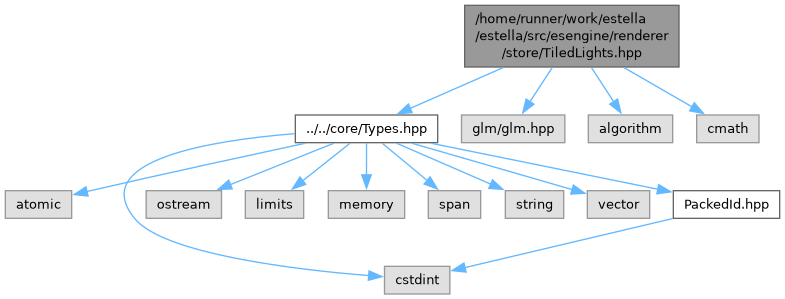

Go to the source code of this file.
Namespaces | |
| namespace | esengine |
Functions | |
| void | esengine::markLightTiles (const glm::mat4 &viewProjection, const glm::vec3 ¢er, f32 radius, u32 index, u32(*masks)[4]) |
Variables | |
| constexpr u32 | esengine::TILE_COLUMNS = 16 |
| constexpr u32 | esengine::TILE_ROWS = 12 |
| constexpr u32 | esengine::MAX_TILED_LIGHTS = 96 |
| Lights a frame can carry through tiles, past the sixteen the loop reads directly. Three words of mask: the fourth is spare. | |
Detailed Description
Which screen tiles a light can reach — the half of tiled forward lighting that is decided on the CPU.
The lighting UBO holds sixteen lights a fragment loops over, which a street at night overruns on its own. The rest of a frame's point and spot lights (up to MAX_TILED_LIGHTS) ride in the same block with a bitmask per screen tile: bit i of tile t says light i can reach a pixel in that tile. A fragment finds its tile from where it lands on the screen and shades only the lights whose bit is set, so the cost follows the lights near a pixel and not the lights in the scene.
The grid is in NORMALIZED DEVICE coordinates — x and y in [-1, 1], y up — which both backends and every camera share: a fragment recovers them from the projection it was drawn through, so there is no viewport size, no framebuffer origin and no sub-rect of a shared surface for the two sides to disagree about.
Definition in file TiledLights.hpp.
