The render targets a frame borrows from, keyed by shape — owned by the frame, not by any one graph that draws from it. More...
#include "../../core/Types.hpp"#include "../rhi/Framebuffer.hpp"#include "../rhi/GfxEnums.hpp"#include <vector>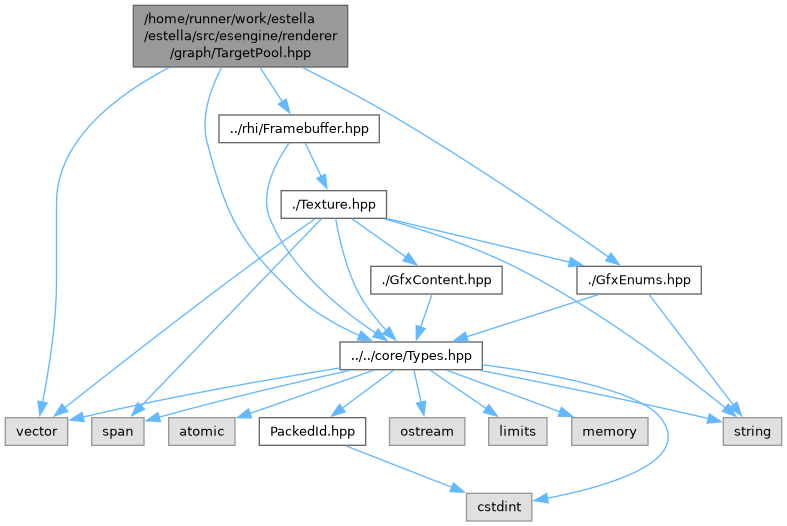

Go to the source code of this file.
Classes | |
| struct | esengine::rg::TargetShape |
| class | esengine::rg::TargetPool |
Namespaces | |
| namespace | esengine |
| namespace | esengine::rg |
Typedefs | |
| using | esengine::rg::TargetHandle = u32 |
| A borrowed target: a slot index, and the generation of what is in it. | |
Variables | |
| constexpr TargetHandle | esengine::rg::kNoTarget = static_cast<TargetHandle>(-1) |
Detailed Description
The render targets a frame borrows from, keyed by shape — owned by the frame, not by any one graph that draws from it.
A RenderGraph is a CHAIN, and a frame holds several of them: one per camera and one for the screen-level stack. While the pool lived inside the graph, every begin() handed every target back, so nothing could be borrowed across two chains — which is why the shadow atlas had to be a framebuffer of its own, created on the first shadowed frame and held for the rest of the run.
Splitting it out makes the lifetime the borrower's to state: a chain's transient goes back at its last read, the atlas goes back at the end of the frame, and both come out of the same physical targets on the next one.
Handles carry a generation. A slot outlives the target in it — evicting frees the memory and leaves the slot to be refilled — so an index alone would let a handle taken before an eviction name whatever landed in that slot afterwards, and a frame holding the atlas across a window resize would draw its shadows into a post-process target. The generation makes a stale handle name nothing.
Definition in file TargetPool.hpp.
