What a vendored Spine runtime owes the module, and nothing more. More...
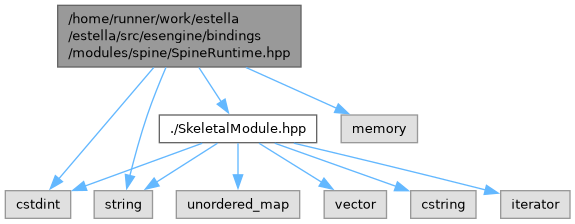

Go to the source code of this file.
Classes | |
| struct | es::spine::SkeletonDeleter |
| Owning handles, so every error path that bails mid-construct still frees. More... | |
| struct | es::spine::InstanceDeleter |
| struct | es::spine::TransformMix |
| struct | es::spine::PathMix |
| struct | es::spine::Event |
| struct | es::spine::ProbeCounts |
| struct | es::spine::ClipStorage |
| struct | es::spine::ClipStartCounts |
| struct | es::spine::PoseCounts |
Namespaces | |
| namespace | es |
| namespace | es::spine |
Macros | |
| #define | ES_SPINE_NS spine |
Typedefs | |
| using | es::spine::SkeletonPtr = std::unique_ptr<Skeleton, SkeletonDeleter> |
| using | es::spine::InstancePtr = std::unique_ptr<Instance, InstanceDeleter> |
| using | es::spine::EventSink = void (*)(const Event&) |
| The module is a singleton, so its collector is process-wide rather than per instance. | |
| using | es::spine::TriangleSink = es::skeletal::TriangleSink |
Enumerations | |
| enum class | es::spine::ConstraintKind { es::spine::Ik , es::spine::Transform , es::spine::Path } |
| enum class | es::spine::EventKind { es::spine::Start = 0 , es::spine::Interrupt = 1 , es::spine::End = 2 , es::spine::Complete = 3 , es::spine::Dispose = 4 , es::spine::Event = 5 } |
| enum | es::spine::RenderStage { es::spine::STAGE_SETUP = 0 , es::spine::STAGE_TRAVERSE = 1 , es::spine::STAGE_VERTICES = 2 , es::spine::STAGE_CLIP_START = 3 , es::spine::STAGE_CLIP = 4 , es::spine::STAGE_EMIT = 5 } |
| enum | es::spine::ClipStartStage { es::spine::CLIP_START_RESET = 0 , es::spine::CLIP_START_WORLD = 1 , es::spine::CLIP_START_WINDING = 2 , es::spine::CLIP_START_TRIANGULATE = 3 , es::spine::CLIP_START_DECOMPOSE = 4 , es::spine::CLIP_START_PIECES = 5 , es::spine::CLIP_START_PUBLISH = 6 } |
| enum | es::spine::PoseStage { es::spine::POSE_SETUP = 0 , es::spine::POSE_ADVANCE = 1 , es::spine::POSE_APPLY = 2 , es::spine::POSE_WORLD = 3 } |
Functions | |
| void | es::spine::destroy (Skeleton *skeleton) |
| void | es::spine::destroy (Instance *instance) |
| const void * | es::spine::eventSource (Instance *instance) |
| bool | es::spine::blendHasPremultipliedTwin (int slotBlend) |
| int | es::spine::blendForPage (int slotBlend, bool pagePremultiplied) |
| The blend code to emit for a slot's mode on a page of the given kind (see above). | |
| void | es::spine::premultiplyTint (float rgba[4], bool pagePremultiplied) |
| Skeleton * | es::spine::loadSkeleton (const void *skeletonData, int length, const char *atlasText, int atlasLength, bool binary, std::string &error) |
| int | es::spine::atlasPageCount (const Skeleton *skeleton) |
| const char * | es::spine::atlasPageName (const Skeleton *skeleton, int page) |
| void | es::spine::setAtlasPageTexture (Skeleton *skeleton, int page, uint32_t texture, int width, int height) |
| void | es::spine::setDefaultMix (Skeleton *skeleton, float seconds) |
| void | es::spine::setMixDuration (Skeleton *skeleton, const char *from, const char *to, float seconds) |
| Instance * | es::spine::createInstance (Skeleton *skeleton) |
| void | es::spine::advanceAndApply (Instance *instance, float dt) |
| void | es::spine::materializeWorldPose (Instance *instance, float dt) |
| void | es::spine::update (Instance *instance, float dt) |
| bool | es::spine::requiresContinuousWorldPose (const Skeleton *skeleton) |
| float | es::spine::animationDuration (const Skeleton *skeleton, const char *animation) |
| void | es::spine::setToSetupPose (Instance *instance) |
| bool | es::spine::playAnimation (Instance *instance, const char *animation, bool loop, int track) |
| bool | es::spine::addAnimation (Instance *instance, const char *animation, bool loop, float delay, int track) |
| void | es::spine::setSkin (Instance *instance, const char *skin) |
| void | es::spine::setTrackAlpha (Instance *instance, int track, float alpha) |
| void | es::spine::setEventSink (EventSink sink) |
| void | es::spine::enableEvents (Instance *instance) |
| int | es::spine::animationCount (const Instance *instance) |
| const char * | es::spine::animationName (const Instance *instance, int index) |
| int | es::spine::skinCount (const Instance *instance) |
| const char * | es::spine::skinName (const Instance *instance, int index) |
| bool | es::spine::bonePosition (const Instance *instance, const char *bone, float *x, float *y) |
| bool | es::spine::boneRotation (const Instance *instance, const char *bone, float *degrees) |
| int | es::spine::boneCount (const Instance *instance) |
| const char * | es::spine::boneName (const Instance *instance, int index) |
| int | es::spine::boneParent (const Instance *instance, int index) |
| bool | es::spine::bonePose (const Instance *instance, int index, float *x, float *y, float *degrees, float *length) |
| void | es::spine::bounds (const Instance *instance, float *x, float *y, float *width, float *height) |
| bool | es::spine::skeletonBounds (const Skeleton *skeleton, float *x, float *y, float *width, float *height) |
| int | es::spine::constraintCount (const Instance *instance, ConstraintKind kind) |
| const char * | es::spine::constraintName (const Instance *instance, ConstraintKind kind, int index) |
| bool | es::spine::transformMix (const Instance *instance, const char *name, TransformMix *out) |
| bool | es::spine::setTransformMix (Instance *instance, const char *name, const TransformMix &mix) |
| bool | es::spine::pathMix (const Instance *instance, const char *name, PathMix *out) |
| bool | es::spine::setPathMix (Instance *instance, const char *name, const PathMix &mix) |
| bool | es::spine::setAttachment (Instance *instance, const char *slot, const char *attachment) |
| bool | es::spine::setIkTarget (Instance *instance, const char *constraint, float x, float y, float mix) |
| bool | es::spine::setSlotColor (Instance *instance, const char *slot, float r, float g, float b, float a) |
| bool | es::spine::setSkeletonColor (Instance *instance, float r, float g, float b, float a) |
| void | es::spine::render (Instance *instance, TriangleSink &sink, bool clipping) |
| bool | es::spine::clipStorage (ClipStorage *out) |
| bool | es::spine::clipStartStage (Instance *instance, int stage, ClipStartCounts *counts) |
| bool | es::spine::renderCounted (Instance *instance, TriangleSink &sink, bool clipping, ProbeCounts *counts) |
| bool | es::spine::renderStage (Instance *instance, TriangleSink &sink, bool clipping, int stage, ProbeCounts *counts) |
| bool | es::spine::poseStage (Instance *instance, float dt, int stage, PoseCounts *counts) |
| int | es::spine::version () |
Detailed Description
What a vendored Spine runtime owes the module, and nothing more.
SpineModuleEntry.cpp implements the exported ABI (SpineBindings.hpp): handle tables, batch packing, the string and event buffers the caller reads back. None of that changes with the Spine release. Everything that does — the runtime's own types, its spelling of "update the world transform", whether slot colour is a struct or four floats — lives behind this header, implemented once per vendored runtime.
Exactly one implementation links into a binary: the web ships a module per version (spine38 / spine41 / spine42 / spine43) and a native host compiles the one its project needs. Selection is therefore a link-time fact, not a runtime one — no vtable, no dispatch, and a backend that forgets a function fails to link rather than failing on a device.
Skeleton and Instance stay incomplete here on purpose: the entry layer only ever holds them by pointer, so it cannot reach into a runtime's structs and quietly grow a dependency on one release's layout.
- Date
- 2026
- Copyright
- Copyright (c) 2026 ESEngine Team Licensed under the Apache License, Version 2.0.
Definition in file SpineRuntime.hpp.
Macro Definition Documentation
◆ ES_SPINE_NS
| #define ES_SPINE_NS spine |
Definition at line 43 of file SpineRuntime.hpp.