Full-screen passes as a declared graph: what each one reads, what it writes, and at what size — the graph decides the rest. More...
#include "../../core/Types.hpp"#include "../rhi/Framebuffer.hpp"#include "../rhi/GfxEnums.hpp"#include "TargetPool.hpp"#include <functional>#include <memory>#include <string>#include <unordered_set>#include <vector>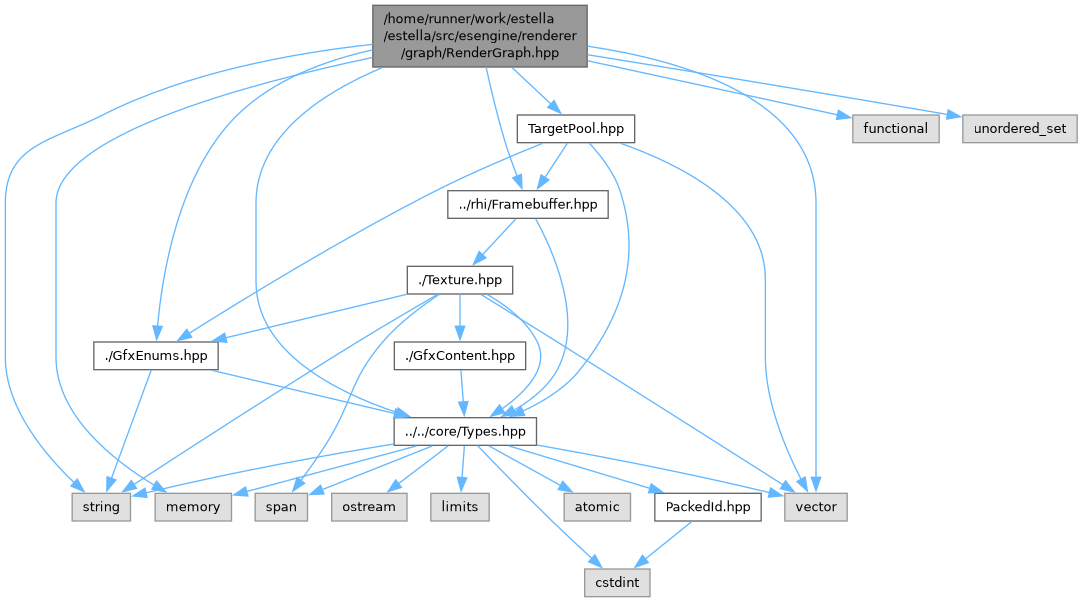

Go to the source code of this file.
Classes | |
| struct | esengine::rg::TargetDesc |
| Shape of a target the graph allocates. More... | |
| struct | esengine::rg::PassContext |
| struct | esengine::rg::PassDesc |
| One full-screen pass. More... | |
| class | esengine::rg::PassTimer |
| A frame's full-screen passes, compiled and run. More... | |
| struct | esengine::rg::PassTimer::Entry |
| class | esengine::rg::RenderGraph |
Namespaces | |
| namespace | esengine |
| namespace | esengine::rg |
Typedefs | |
| using | esengine::rg::ResourceId = u32 |
Variables | |
| constexpr ResourceId | esengine::rg::kNoResource = static_cast<ResourceId>(-1) |
Detailed Description
Full-screen passes as a declared graph: what each one reads, what it writes, and at what size — the graph decides the rest.
The chain it replaces was two fixed framebuffers ping-ponged in order, which fixes three things it should not: every pass runs at full resolution, a pass can only read the one before it (plus the scene, wired to a hard-coded unit), and a disabled pass still costs its target. Here a pass names its inputs and its output's SCALE, so a blur chain runs at a quarter size, a composite reads both the blur and the scene, and a pass nothing reaches is never run.
Physical targets come from a pool keyed by shape and handed back the moment a resource is last read, so the two-buffer ping-pong is what the allocator does on its own for a linear chain rather than something the caller arranges.
The graph does NOT own scene geometry: the scene is rendered into an imported texture by the frame, and the graph runs over it. See PostProcessPipeline.
Definition in file RenderGraph.hpp.