Which baked grid a point stands in, and what it says there. More...
#include "../../core/Half.hpp"#include "../../core/Revision.hpp"#include "../../core/Types.hpp"#include "../../core/Hash.hpp"#include "../../resource/ProbeVolume.hpp"#include "./ProbeConstants.hpp"#include <algorithm>#include <cmath>#include <glm/glm.hpp>#include <vector>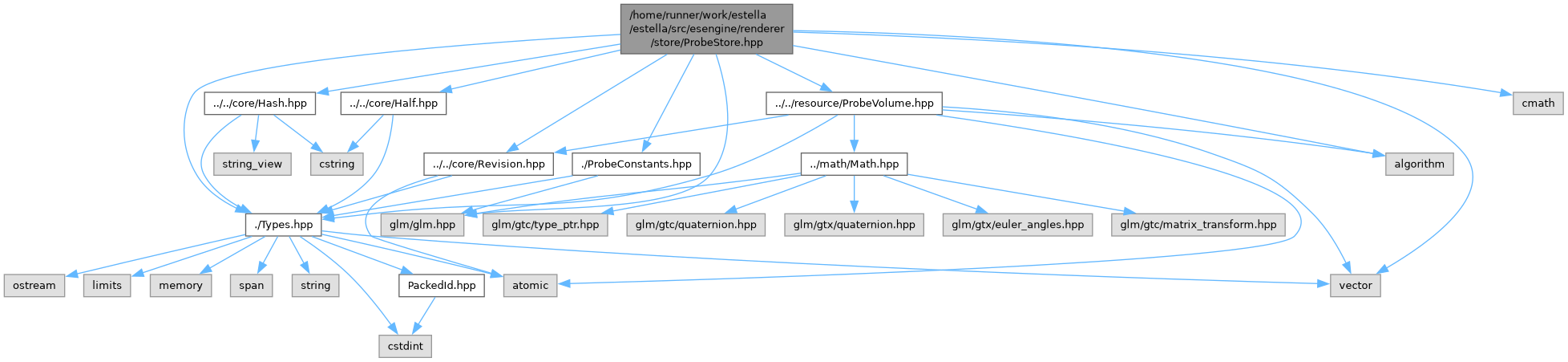

Go to the source code of this file.
Classes | |
| class | esengine::ProbeStore |
| The frame's probe volumes, and the trilinear read through them. More... | |
| struct | esengine::ProbeStore::Volume |
| One volume: a world box, and the grid solved inside it. More... | |
Namespaces | |
| namespace | esengine |
Detailed Description
Which baked grid a point stands in, and what it says there.
The frame's LightProbeVolume components, as bounds plus the grid each one reads. Filled during collection and read during collection — a volume is borrowed, not copied, so nothing here outlives the frame that gathered it.
Two ways a draw reads one. Per object: the nine coefficients where the draw stands, read here on the CPU — one value for the whole mesh. Per pixel: the grid itself, packed into the frame's probe atlas, and the draw's run says where in it — so one merged mesh spanning a shed and the yard outside is dark under the roof and lit in the open.
The atlas is a 3D texture of BRICKS, the shape a sparse volumetric lightmap takes: a grid is cut into blocks of kBrickCells cells a side, each stored kBrickTexels texels a side so that a brick carries the probes on its far faces too and the hardware's trilinear filter never reaches past it. An indirection cell per brick says where its brick sits. A dense grid is every brick at one size; a sparse one will point a run of indirection cells at one coarse brick (the span its indirection texel carries).
Definition in file ProbeStore.hpp.
