Loading...
Searching...
No Matches
MaterialBindings.hpp File Reference
Material + .esshader entry points, for whichever core is embedded. More...
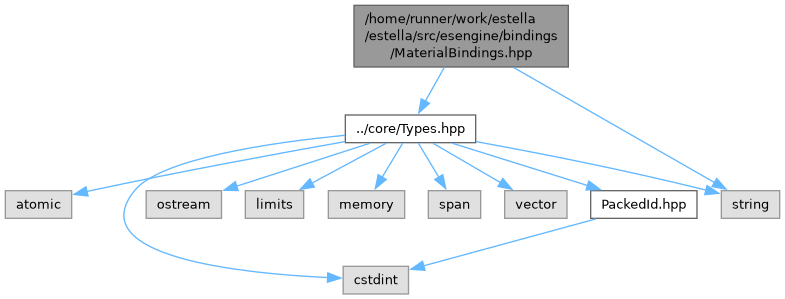
Include dependency graph for MaterialBindings.hpp:
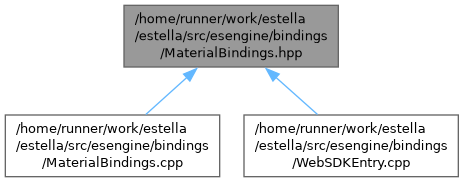
This graph shows which files directly or indirectly include this file:
Go to the source code of this file.
Namespaces | |
| namespace | esengine |
Functions | |
| u32 | esengine::material_compileEsshader (const std::string &source, const std::string &featuresCsv) |
| void | esengine::material_define (u32 materialId, u32 shaderHandle, u32 blendMode, u32 flags, i32 depthBias) |
| void | esengine::material_setUniform (u32 materialId, const std::string &name, u32 arity, f32 v0, f32 v1, f32 v2, f32 v3) |
| void | esengine::material_setTexture (u32 materialId, const std::string &name, u32 textureHandle) |
| void | esengine::material_undefine (u32 materialId) |
Detailed Description
Material + .esshader entry points, for whichever core is embedded.
A material is engine-side data: the SDK compiles its shader here, then pushes the resolved render state and param values, and the render path reads them by the handle a component carries. These used to live in the web entry point as hand-written embind, which made every material — and every post-process pass, whose shader compiles through the same material_compileEsshader — web-only by construction. Declared here, EHT generates the native wrappers from the same source embind registers.
Definition in file MaterialBindings.hpp.
